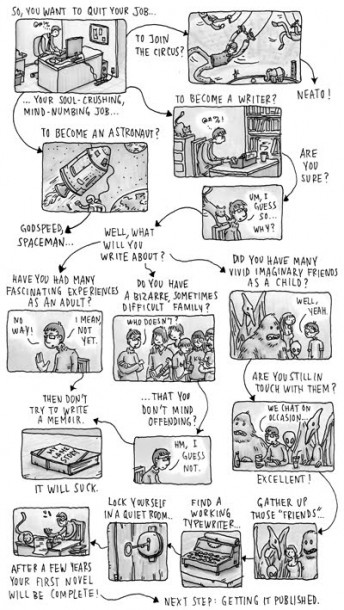
– click for huge –

“The Process of Writing a Novel” by Maureen McHugh
(via Austin Kleon)
I’m tired of making excuses to myself. So in a fit of pique I scribbled out a list of all the reasons I can think of not to write.
These are transcribed exactly how I wrote them, questionable grammar and all.
1. It’s hard.
2. I can’t make a routine because of my shifts @ work.
3. I’ll never make a living at it. (why bother?)
4. My friends are humoring me.
5. I’ll probably get sued.
6. No one reads horror.
7. I’ll never get rich writing e-books.
8. The internet is more fun.
9. I need uninterrupted time and quiet and a thunderstorm or perfect Fall sunlight and…
10. Who do I think I am, anyway?
11. My ideas are stupid and no one has told me.
12. I don’t like to give up other things to make the time.
13. The tax forms are confusing.
14. It’s all been done before.
15. I can’t describe exactly what I see in my head.
16. I’m afraid of cliches.
17. I don’t have a proper editor and am probably making so many mistakes.
18. My office is messy.
19. I want the lifestyle but I don’t want to put in the work — I want it just to happen.
20. My job gets in my way.
21. It’ll just get stolen anyway.
22. There are a million other people doing the same thing as me at the same time as me.
23. I don’t have an English degree.
24. I’m already behind on The Plan.
25. It’s a pain to lug my laptop around.
26. I could write more at work if there was a table in the locker room for me to sit at.
27. I’m not great at networking.
28. I can’t concentrate.
29. What if I actually write a novel then hate it?
30. I’m scared.
Honestly, there are some thoughts on this list that I’m not especially proud of. But I’m glad I wrote it out: the whole list was written in only a couple of minutes, and it felt good to get it out of my system. I figured I’d post it here as a confession of sorts. There must be other (new) authors out there feeling at least some of these things.
Now that I see it in front of me, I can see how ridiculous some of these thoughts are, and how the “obstacles” that seemed so big are really just me being lazy or cowardly or…
Feel free to make whatever comments you’d like on this one: I’m having an introspective Let’s Get Real kind of moment. Do you share any of these feelings? What are your go-to excuses?
I figured out why I was having problems meeting my daily word quotas.
It wasn’t hard enough.
I’m a hugely competitive person, and I tend to only really enjoy things that at first seem insurmountable. Looking back, I think I set my initial word goals too low. I had decided on an arbitrary number, that I knew I could accomplish, so as not to get frustrated and give up.
Instead, the opposite happened: it was too easy to reach my goal, which made my subconscious decide it was not worth doing. Something done by rote becomes boring, and what’s the point of doing something boring?
Way to screw me, Brain.
SO: my solution is to increase the number of words I expect out of myself. I’ve set my new goal at nearly double what it was before, and it seems to be working. Suddenly my brain is processing it as Shit! That’s a lot of words! Better work harder! and the ideas are back. The numbers are back.
Since there’s a worry now that I can’t possibly reach my new goal every day, I have to try harder, which makes me focus more.
My tip of the day: write scared.
“Writer’s Block. It sounds like a fearsome condition, a creative blockage. The end of invention. But what is it, really?
Part of why Writer’s Block sounds so dreadful and insurmountable is the fact that nobody ever takes it apart. People lump several different types of creative problems into one broad category. In fact, there’s no such thing as “Writer’s Block,” and treating a broad range of creative slowdowns as a single ailment just creates something monolithic and huge. Each type of creative slowdown has a different cause — and thus, a different solution.
Instead of feeling overwhelmed by the terrifying mystique of Writer’s Block, it’s better to take it apart and understand it — and then conquer it.”
I was talking to a couple of acquaintances, one of whom is in the process of building a house. Let’s call her…oh hell, it’s late. We’ll call her A. A was exhausted and still had months of work to put in before the house would be complete. Exhausted, she flopped down at the table and sighed. The other one…Z…asked what was the matter.
“Oh, I just have so much work to do. The whole house still needs to be painted.” A’s eyes lit up and she addressed the both of us. “You wanna come paint this weekend?”
I blurted out “No!“, then explained that I had scheduled some novel-writing time that weekend. (Also? There is no chance in hell I’m painting your house.)
She grinned and offered to trade, then said, “Don’t worry, I’m kidding. I can’t write.”
Z jumps in: “But writing a novel would be way easier.”
Wait, what?
“A has to paint the whole house. That would take way longer.”
I sputtered and had nothing to say, which if you know me says a lot. It’s faster to write a novel? Really? Then what the hell is my problem?
comic by Grant Snider (no relation)
(via WilliamLanday.com)
Welcome new followers, I’m glad you’re here.
I’m reposting my free horror story, Dump Room, for those of you who haven’t read it yet. Let me know what you think!
This one’s silly and gross, and I had a blast writing it. Enjoy! -Stefanie
Dump Room
Melissa pried back the white plastic lid and tipped the bucket unceremoniously over a large sieve.
A hand flopped out and lay there in the plastic mesh, palm up, fingers curled.
She leaned over to get a better angle through her thick plastic mask. Female, looks like. Huh.
Once the hand had drained, she lifted the sieve and flipped it over into a lined container marked BIOHAZARD. The hand fell wetly on top of the sundry pieces already laying there; a gallbladder, a kidney, a tumour with the eye and lid still attached.
The mask she wore was chafing again. She scrunched her cheeks, trying to unstick the rubber gasket that was gouging a raw red ring into her skin. It wouldn’t budge, stuck slick against the sweat beading on her face. She sighed, the sound amplified oddly behind the industrial mask.
Better get a couple more done before break, she thought.
Sighing inwardly, she reached for the next bucket. The shelves were full this time; it would take her the rest of the day, easily, and maybe some of the next.
It hadn’t been her first choice, this job. It wouldn’t be anyone’s. But it was necessary.
An overtired supervisor had shown her to the dim room. It was cramped, tucked in behind the Pathology labs, and even through the door Melissa could smell the chemicals inside.
“This is the dump room,” the woman, Cheryl, had said. “Anything comes offa you or outta you, we keep it here in case someone decides they want to sue us. After six months, everything in here’s gotta be thrown out.” She’d swung the door wide and swept Melissa inside.
“Masks, here.” She pointed as she spoke. “Gowns, gloves, shoe covers. Buckets. If you can’t get them open, I can get you a pry tool, but I don’t like to use them. More chance of a splash.”
Melissa had hoped her grimace wasn’t obvious.
“Now, you need to know that these containers might hold anything. Breasts, feet, products of conception.” She’d looked at Melissa, her eyes softening a little. “That’s babies. Miscarriages, abortions. If you can’t deal with that we can find someone else.”
“No, I’ll be fine,” Melissa said, her voice cheerful, wanting so badly to make a good impression. Anything to get a job here. Anything.
Cheryl had nodded curtly and slipped out, leaving Melissa alone with pieces of strangers.
That first time the job had been half done already; Cheryl said the intern before her had moved on suddenly. Melissa had made short work of the dumping, and had been given the dubious honour of “Disposal Attendant”. The job paid next to nothing, but her internship was unpaid altogether and she was nearing the end of her loan.
Now she peeled back the opaque plastic lid.
Weird, she thought, there’s nothing in this one.
She swirled the murky preservative around; still nothing surfaced. She shrugged and poured the liquid out in the dump sink beside the sieve.
An ear, badly burnt, plopped into the shiny steel sink. It lay there, shrivelled and raw.
“Gross,” she said to the empty room. She flexed one gloved hand and reached down to pick it up. Her fingers stopped just shy of the lobe; for a second she thought of what it might feel like and almost didn’t touch it at all.
She’d imagined hard brittleness, but what she felt when she plucked it from the sink was warm soft flesh.
Reflex made her fling it away; it stuck to the back wall of the sink and began, before her horrified eyes, to slide back down.
She gagged a little.
Finally it flipped end over end and came to rest again by the drain.
Melissa looked around for tongs, pliers, anything so she wouldn’t have to feel it’s warmth against her glove. She found a pencil lying along the back of the counter, but couldn’t bring herself to pierce the tissue.
Reluctantly, she extended her hand again. She exhaled, steeled herself, and scooped the offending organ up. She tossed it into the waste box, where it vanished down the side.
Melissa shuddered. Screw this. I’m taking my break.
She shucked her gown off and turned to hang it on the hook.
A sound, a very, very quiet sound, came from behind her.
She stopped, held her breath, waited.
It was muffled, but it was there. The crackle of shifting plastic.
She knew right away, but she turned to be sure: it was coming from the box on the floor. The big yellow one with all the…parts.
She moved closer, shoved the box with the toe of her sneaker.
Waited.
Nothing. Stop being a dumbass.
She peeled the thick rubber gloves down and flung them onto the counter. The booties could wait—they were a pain in the ass anyway.
She nudged the lid into place with one denim-clad knee and turned to leave.
Wait.
The lid had been on, firmly, before she took her gown off. Cheryl had stressed the importance of covering the…waste…as a personal safety precaution. Melissa had clamped the lid down, she was sure of it.
But then it had been open, just a little, tilted back on an angle.
You’re losing it. Get out of the fumes.
She turned
then
a long, slick piece of intestine coiled its way up her leg. Melissa shrieked and kicked, trying to dislodge the thing. It only snugged tighter, climbing higher until it reached her thigh. One end swung itself across her and wrapped around her other leg, rendering her immobile. The other end was still pinched in the lid of the hazard container.
She screamed then, the shrill sound dead against the insulating rows of plastic.
Her hands shook; her body shuddered. This isn’t happening.
She forced a quivering hand down and pulled at the ropey gore, but it was steadfast. And the lid was sliding back again…
Melissa tried to scissor her legs apart; to force enough slack to run.
A fingertip appeared. Two. The hand gripped the lip of the waste box and tensed, trying to pull itself over. Suddenly it fell, pushed by a blob of amorphous meat that splatted down beside it.
The intestine was squeezing harder, made stronger by the chemicals that preserved it. It was up to her stomach now. She gaped down in horror. Dark blue veins pulsed with hideous life. A wet trail of chemical fixative marked its ascent. The pockets in the intestine contracted and expanded, propelling it as it slithered up toward her chest.
Bits of gore rained down from the yellow bucket on the floor and began inching closer. The errant ear from earlier rode perched atop the gnarled hand, whose cracked and blackened nails clicked on the tile as it approached.
The hand reached her in seconds, it seemed, and began tugging on her pant leg. Its fingertips clenched the fabric, urging her back towards the spreading pool of excised tissue. The grisly stump at the wrist thumped against the floor as it pulled.
The intestines were almost at her neck now, cuddled into the hot pulse at her throat. The severed end reached up and lovingly stroked her face—
The door behind her swung open.
Instantly the undead tissue fell to the floor, harmless again.
Cheryl stood in the doorway, mouth open in shock as she surveyed the scene. Bits and pieces lay scattered around the floor. Melissa stood stiff at the centre of the carnage.
“What the hell are you doing in here?” Cheryl demanded.
“It…they…attacked me!”
“They who?”
Melissa struggled to speak. The open end of intestine lying across her shoe burped, releasing a mouthful of fixative.
She ran, screaming, from the room. Cheryl watched her go with open disgust.
“They think they’ll handle it, but they never do.” She sighed, grabbed some gloves from her pocket, and set about cleaning the glistening mess.
Pick someone you loathe.
Come on, everyone has one. Yours could be someone famous, I suppose, whose morals or actions you disagree with. But that’s no fun. I want you to think of someone in your real life that drives you batshit. It could be a family member. A neighbour. That one woman at work whose voice makes you want to pull your own ears off so you can more easily stuff something, anything inside the holes and finally have some blessed silence.
I mean, if you know someone like that, you could use them for this game*.
Okay, so you’ve got your loathee picked out. Your job is to get into his or her head. What do they do at night? What’s their guilty pleasure? What’s in their bank account? How do they view themselves? What’s their secret? Set up shop and poke around a little.
Now experience an obstacle, as your loathee. The plumbing has burst, and there’s a jet of water shooting across the room. The car broke down, and the next paycheque isn’t due til next week. And by the way, that promotion went to someone else.
What does your loathee do? What are they thinking? What’s their mood like? Do they lay blame, and if so, on who?
You can play this game in two ways:
1. For the greater good.
Maybe by imagining what’s going on in this person’s life and thoughts will help you to understand them a little better. Maybe you’ll learn to let old grudges go, to be more accommodating to the quirks and nuances of someone you never much cared for. You’ll better communicate with someone you understand.
OR
2.Sweet, sweet evil.
That weird smell your loathee gives off? That’s because he sacrifices cats by the light of the full mooon: what you’re smelling is singed fur. And the reason she doesn’t listen is because she’s stuffed cork in her ears to compensate for a tragic deformity wherein her brains leak out if she tilts her head (which also explains why she’s so dumb). Run with it, ascribe any horrible fictional trait you like, but base it loosely in fact. Flex your imagination.
But why someone you don’t like?
Picking someone you don’t like gets you outside your comfort zone. It’s easy to imagine someone just like yourself; simply plug in your own ideals and reactions and it’s done. But often the people we don’t like are the people we don’t get. There’s the challenge: you have to get out of your own head before you can get into anyone else’s. (Like, oh, I don’t know…a character? They can’t all act/think/speak just like their authors, if the story is any good.)
(This is the part where writing books would tell you to write this shit down. Why? So you can relive it later? Nuh-uh, this is a GAME, and it won’t be FUN anymore if you make it too much like WORK. Besides, if you play only in your head, you can play in public…this broadens your target candidate base exponentially. Mwuahahaha.)
Give it a shot, and let me know what you think.
*Why “game”, when most people call it a writing “exercise”? Because one of these things sounds like way more fun than the other, that’s why.

 sniderwriter