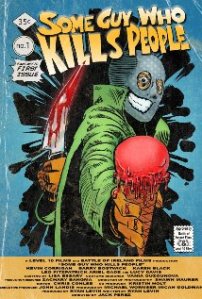
Movie Monday: Some Guy Who Kills People

I started watching this one thinking it would be easy enough to pick apart. I mean, seriously. Some Guy Who Kills People?

But I found myself just watching, entranced. I loved it. In fact, I absolutely adored it.

The dialogue is perfect: concise, punchy, subtly funny:
(Sheriff and Deputy, upon discovering a decapitated victim)
“This thing has no head, Ernie.”
“I know, Sir.”
“Most bodies have heads.”
“Absolutely.”
“Where’s this thing’s head?”
“Not sure yet, Sir.”
“Well we should find his head.”
“Good idea, Sir.”

It has the same candy-coloured, cute-horror, slightly-fifties aesthetic as Fido. The main actor (Kevin Corrigan) reminds me of a dark, damaged Mark Ruffalo (in fact, this movie is just like The Kids Are All Right, except it has less lesbianism and way more brutal violence). It has everything I love: comics, over-the-top violence, dark humour, a diner, a smart-ass sheriff, a foam ice-cream costume, crushing social awkwardness…

Are you watching it yet? You should be.

Movie Monday: Lessons On Show and Tell From “Sinister”

©This Is Not a Dream Productions

Every writer’s heard it a hundred times: Show, don’t tell.

Showing in writing is always emphasized. It’s more interesting for the reader to take a clue (Steve’s heart raced) and figure out what it means (Steve was scared) instead of being told. Sure, it may mean you and I reach slightly different conclusions, and we probably form different mental images. That’s part of why we read. By not supplying all the details, the writer leaves the reader to imagine the story and characters exactly how they want.

What “Sinister” shows us is the need for balance between showing and telling.

The movie begins by cutting back and forth between a voodoo practitioner and his intended target. The suspense of the scenes and the contrast between light and dark, noise and silence, is actually really well executed. We’re drawn into the movie from the start. I wish we knew more about why the guy’s making a voodoo doll of the girl, but it feels like we’ll find out in time.

The problem is that suddenly we’re following an older woman in her car. She’s talking on her cell phone to her boss (?), then gets stuck in a car wash, then goes home to find her brother visiting. I’m not saying the writers should have held our hands, but this is an instance where I think they could have used a little more tell.

How are these women connected? Are they connected? As a viewer, it’s easy to fall out of the suspense because we have no way of knowing how and if these stories intertwine. I’d be more worried for the woman if I knew the bad guy was killing off a family, and she’s next. Or if I knew that the woman is the bad guy’s mother, and he’s got it out for the women in his life. At least give me a hint. As it is, I’m left hanging, given too little information, and it’s hard to hold interest.

This movie is also a good example of something that bothers me in writing. So far all the characters have been “singular” in the sense that most scenes occur with only one person. [this does change later; I was blogging as I watched. Still relevant.] It would seem logical, then, that there would be an absence of dialogue, but in reality the scenes become tedious. If I were reading this story as a novel instead of watching it as a movie, it would go something like this:

(the female character with no name) makes tea. She hears a bell. She goes to look. Finds the bell. Picks it up. Closes the door behind her. Door opens again. She closes it. She reads in bed. She goes to sleep. She hears a noise.

Tiresome, right? It wouldn’t serve to have her wandering the house talking to herself, but we also don’t hear her thoughts. Without any real input from the character about what she’s thinking, we can’t ever learn about her. And if we don’t know anything about her, we don’t care about her. It’s important to give the reader clues (again) that help to establish who this woman is. To a point, telling can be used to give us a little background so we’re not forced to supply everything.

Lessons from Sinister: try to walk the line between being patronizing and being frustratingly vague. Suggest that all will become clear as the story progresses, then plot the story to tie up loose ends.

Movie Monday: Lessons on Writing from “The Horrible Sexy Vampire”

Horrible Sexy Vampire

The movie starts with an invisible murderer killing a man in the shower. Alright, not bad. Then what happens?

NOTHING. NOTHING HAPPENS. IT’S SO BORING.

Well then, what can we gain from watching The Horrible Sexy Vampire? It teaches a lot about how not to write dialogue—NEVER EVER write like this*. (Lines appearing one after the other are as spoken in conversation. I’ve tried to interpret the punctuation so you can “hear” it in all its glory.) Enjoy.

Unlikely characterization: “In my opinion, we cannot prove nor disprove the existence of vampires.” A pathologist, presumably a man of science, arguing with a logical police investigator.

Exhaustive exposition: I was going to transcribe the pathologist’s statement of how we “know” it’s a vampire going around murdering these people (including math equations!), but it’s just paragraph after paragraph of blather. The characters just stand there, static, while one talks at the other.

Awkward delays in plot: “That baron should be buried downstairs in the cellar, and so should his wife. We may be able to open their tombs.” “…What do you suppose they’ll hold, other than their crumbling bones?” “First we’ll have to find the door.” “Of course.”

“Explaining is stupid; why should I bother?” Yeah, I have nothing to say about that one.

“Written” language rather than realistic speech: “I dislike idle conjectures.”

Lack of editing-slash-logic: “…the last owner had no children.” “Are you referring to my mother?”

Characters don’t really talk to each other, they just talk: “Pardon my indiscretion, but what is it you do in London?” “Well, I’m not actually forced to do anything. I have a steady source of income and devote myself to my hobby of taxidermy. I should say I spend a huge amount of my time doing that.” “How interesting. You’re really most kind. Many thanks again.”

Throwaway dialogue: “What’s the time?” “It’s three past midnight go to bed.” “Tomorrow then bye.” (two barmaids)

Major lessons to take away: watch pacing and dialogue. Eliminate lengthy walking sequences where nothing happens. Make sure characters actually communicate instead of just blurting dialogue at each other. Also, edit for realism: I doubt a real cop would go on at length about intimate murder-case details to a perfect stranger (who, by the way, is also a suspect).

Runners-up for awfulness: One character literally rubs at his eyes in disbelief, on two separate occasions. Also, surprise vampire necrophilia.

Kudos, though, to the invisible vampire: a trait somewhat underused in vampire stories. That’s the only compliment I can give this one.

*This movie was originally in Spanish; but my argument stands. Someone still made these horrible dialogue choices when the screenplay was translated. And the plot speaks the universal language of suck.

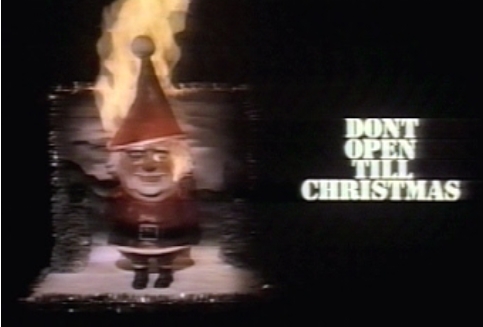
Movie Monday: Don’t Open Till Christmas

I thought I’d get a little festive.
This came from one of my Mill Creek collections (Drive In Movie Classics) and is presented in glorious VHS-redubbed quality. There will be spoilers in this review, so if you want to keep this magnificent film’s artistic integrity intact, you might want to come back another day.

Let’s start from the beginning: creepy mouth-breather sneaking up on a couple making out in a car. The male of the pair has just gotten off his job as a back-alley Santa, which seems to be the schtick in this movie. I’ve never been to England, but here in Canada our Santas sit in malls instead of roasting chestnuts in dank cobbled laneways.

Anyway, our mouth-breathing friend goes all stabby, then suddenly we’re at a costume party (?) where the next Santa gets shanked with what amounts to a homemade javelin.

The news reports on the trend of Santa-murder, but that doesn’t stop anyone from wearing the exact same bad Santa costume and parading through circuses and weird sex dungeons. Yep, you read that right.

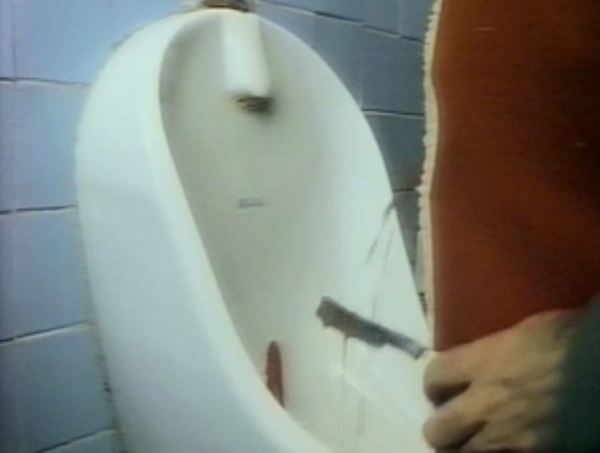
There follow a series of murders, and mandatory female nudity, including one woman who goes outside wearing nothing but a Santa cape. Our villain finds her, but upon discovering she’s female, leaves her.
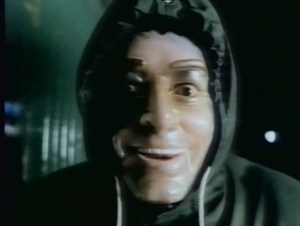
I mean, he has standards.

Our Santas run around being drunk and getting up to debauchery.

This one’s at a peepshow: “I’d like to have you sitting on my knee.”
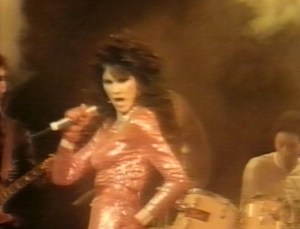
Then one stumbles into a music video? I don’t even know.

Meanwhile, our heroine (whose name I don’t recall, because I was simultaneously reading Memebase so enthralled with the plot) is trying to get over the murder of her father. She accomplishes this by busking in the street with her asshole boyfriend, who seems remarkably unphased by the murders. Ooooh, is he the killer? Wait for what feels like ten more years to find out!

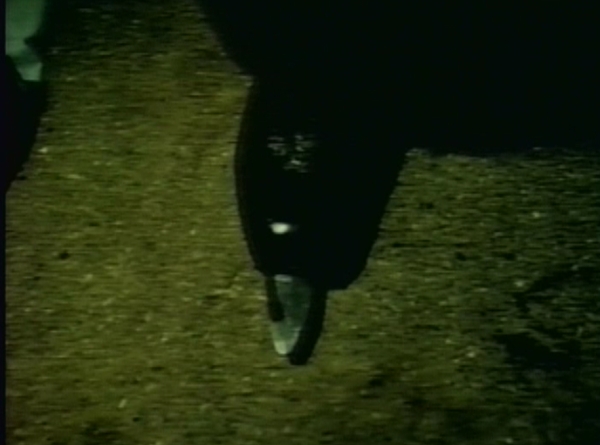
Blah blah more murders, more nudity, then BAM! Knife in a shoe!
Crafty.

Yet men still keep dressing up in the same horrible Santa costume, and keep getting picked off.

It’s exactly what you think it is.

Our psycho goes slinking around acting generally sketchy.
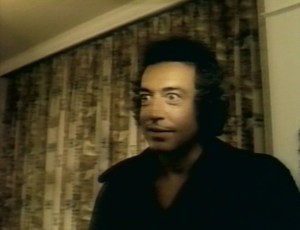
He looks perfectly sane. Really.

Pretty well everyone dies, which is about right for a schlocky horror. But what, might you ask, made our psycho hate Christmas so much? Could it have been, say, a traumatic childhood incident?
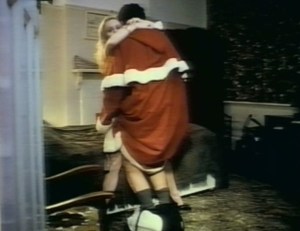
Oh.

The dialogue is alright, it’s the plot and the wooden acting that make it awful.

I haven’t determined a ratings-system for these yet, because frankly I’m hoping all the movies I review will be terrifically cheesy. However:

Watch for: the surprisingly clever killer-killer

Cringe at: the awful soundtrack that plays over every. single. scene.

Guess: what’s in the box. Dun-dun-dunnn…