A Story-Shaped Trap

This novel is still coming along nicely. It’s exciting, because normally by now I’ve fallen out of love with a story I hate the story’s guts, and I’m angry at each individual letter on the screen for conspiring against me to form words that suck.

Anyway.

I’m still so new to this whole actually-completing-work phase of my fledgling career that it’s hard to know how to pace myself. As we’ve seen in—ahem—other areas of my life, I tend to run myself ragged, trying to do more, and eventually I burn myself out.

So I’m trying to develop a writing plan, as in x number of hours per day or x number of words. To pace myself and actually know when to knock it off, already. But there’s some small part of me that thinks if I don’t WRITE THIS WHOLE THING RIGHT NOW OMG it will stop being exciting, and I’ll dump it like I did its predecessors. I keep getting little mental flashes of really neat scenes, and I feel like I need to capture everything now, for fear it won’t be as good later.

So my question is this: how do you strike a balance?

Movie Monday: Lessons On Show and Tell From “Sinister”

©This Is Not a Dream Productions

Every writer’s heard it a hundred times: Show, don’t tell.

Showing in writing is always emphasized. It’s more interesting for the reader to take a clue (Steve’s heart raced) and figure out what it means (Steve was scared) instead of being told. Sure, it may mean you and I reach slightly different conclusions, and we probably form different mental images. That’s part of why we read. By not supplying all the details, the writer leaves the reader to imagine the story and characters exactly how they want.

What “Sinister” shows us is the need for balance between showing and telling.

The movie begins by cutting back and forth between a voodoo practitioner and his intended target. The suspense of the scenes and the contrast between light and dark, noise and silence, is actually really well executed. We’re drawn into the movie from the start. I wish we knew more about why the guy’s making a voodoo doll of the girl, but it feels like we’ll find out in time.

The problem is that suddenly we’re following an older woman in her car. She’s talking on her cell phone to her boss (?), then gets stuck in a car wash, then goes home to find her brother visiting. I’m not saying the writers should have held our hands, but this is an instance where I think they could have used a little more tell.

How are these women connected? Are they connected? As a viewer, it’s easy to fall out of the suspense because we have no way of knowing how and if these stories intertwine. I’d be more worried for the woman if I knew the bad guy was killing off a family, and she’s next. Or if I knew that the woman is the bad guy’s mother, and he’s got it out for the women in his life. At least give me a hint. As it is, I’m left hanging, given too little information, and it’s hard to hold interest.

This movie is also a good example of something that bothers me in writing. So far all the characters have been “singular” in the sense that most scenes occur with only one person. [this does change later; I was blogging as I watched. Still relevant.] It would seem logical, then, that there would be an absence of dialogue, but in reality the scenes become tedious. If I were reading this story as a novel instead of watching it as a movie, it would go something like this:

(the female character with no name) makes tea. She hears a bell. She goes to look. Finds the bell. Picks it up. Closes the door behind her. Door opens again. She closes it. She reads in bed. She goes to sleep. She hears a noise.

Tiresome, right? It wouldn’t serve to have her wandering the house talking to herself, but we also don’t hear her thoughts. Without any real input from the character about what she’s thinking, we can’t ever learn about her. And if we don’t know anything about her, we don’t care about her. It’s important to give the reader clues (again) that help to establish who this woman is. To a point, telling can be used to give us a little background so we’re not forced to supply everything.

Lessons from Sinister: try to walk the line between being patronizing and being frustratingly vague. Suggest that all will become clear as the story progresses, then plot the story to tie up loose ends.

Writing a Novel? Cool Story, Bro.

Since I mentioned starting to write a novel, I’ve had mixed response from people I know. Most have been supportive, as I knew they would.

A few, though, have been a little skeptical. No one’s said it, of course. But there’s a certain look in the eye, a certain…pause…before saying anything, that gives it away.

I can see why.

Writing a novel seems to be one of those things that people say they’d like to do someday. I’d say a majority of people feel, at one time or another, that they could write a book. Most people say it, but most never do it.

Which brings me to the skeptics in my life. Because I’ve announced my intentions of “one day” making a living at writing, I can see how that might be mistaken for the same wistfulness that plagues so many wannabe novelists. Most people who have “one day”s sit back and wait for it to happen. “One day” I’ll run in that marathon. “One day” I’ll ask that guy out. They don’t make any concrete move toward their goals.

I say “one day” because there are so many variables. I can’t make someone like my work. I can’t make them buy it. And if no one buys it, it will never pay the bills. That’s life. I say “one day” because there’s no way for me to set an exact timeline for when I’ll be able to make writing my only job.

All I can do is fulfill my side of the contract. I can only control my output. I have to write, every day, no matter what, if there’s any hope of making it. I have to get better with every story, because it’s my job not to disappoint the reader. I have to bust my ass to make this novel the best I can. And the novel after that. And the one after that. Then I have to get my stuff out there, get people to see it, and hope like hell they like it.

Whether or not my “one day” ever comes rests squarely on my shoulders, and if I don’t work for it it never will.

(This post was inspired by someone who demanded I recruit followers for their writing instead of doing any work themselves. It doesn’t work like that. Sorry, Bro.)

Insomnia, My Best Worst Friend

Couldn’t sleep last night. That won’t surprise many of you; I have sleeping…issues. Mostly I can’t get settled, can’t shut my brain off. The longer I lie there, not sleeping, the more resentful I become. It starts off a horrible cycle where I’m angry because I can’t sleep, and I can’t sleep because I’m so angry. I finally drifted off around 4:30. I had to be up at 5:30 for DayJob.

Why am I telling you this?

BECAUSE…as I stared off into the darkness, my mind wandered and BAM! fell right into an idea. An idea for a novel. Pieces fell together and suddenly I had a loose outline, a title, hell, even a cover all planned out.

I rolled over and told myself I’d revisit it today, to see if any of my half-asleep ramblings actually made sense. I even (and this is a cardinal sin: writers, look away) decided not to get up and write any of it down. I figured I might forget it, sure, but it was late and I was busy in the throes of a bitchy little funk.

Luckily, it stayed with me. And the more I think about it, the more I like it.

I’ve never had a story come together so easily before. I have whole little mind-movies climbing over each other to be written. And they make sense and they work.

This is easily the most excited I’ve been about a story, and I owe it all to that sleep-sucking rat-bastard. Silver linings, I guess.

(And no, I won’t tell you what it’s about)

The Joys of Editing. No, Really.

I edited the hell out of a story last night. I changed almost everything and mercilessly butchered my darlings until only the proudest were left standing. The more I edited the more I realized the first draft really had been…less than great. A little wooden and a whole lot disjointed. Shitty, to be blunt. As I was editing, I kept wondering how I’d ever liked the story in the first place.

And still, this morning, I’m pretty high on accomplishment. I love the story now. It’s decent, and it flows, and dare I say it’s even a little funny.

A huge part of why I used to give up on stories is that when you’re writing the rough draft, it’s easy to hate the story. Sometimes it’s easy to hate yourself a little, too. I’m no good at this. How the hell did I ever expect to get anywhere? It will never be good. My friends and family are just being kind and really they think I suck ass.

I’d heard all the quotes from famous authors belittling the first draft, bitching about how the first draft sucks, will always suck. I heard it, but I didn’t believe it. Surely, these incredible artists were just being modest, or were venting their frustrations hyperbolically.

It took me a long while, years, to feel the truth of what I’d been hearing.

So from someone who’s not a famous author (yet), if you’re teetering on the precipice, pay attention: it sucks. It will suck, hard. But the joy is in fixing all those what-the-hells, smoothing and sticking together the jagged bits with Bondo and silly-string and whatever else you keep in your bag of tricks.

Now I realize that the worse the rough, the more fun it is to attack it in editing. Now you have a basic plan in mind, a beginning-middle-end of some sort, and you get to run in there, machete swinging, and mercilessly mow down anything that invaded your story’s territory when you weren’t looking. Stupid character? Whack ’em. Boring part? Light something on fire and watch ’em panic. The best part is seeing what you can do to mix it up a little.

So take joy in your shitty first drafts. Look forward to the cruel revenge you will take on anything that dares not be good. Keep a metaphorical knife in your teeth and madman’s glimmer in your eye. Love it, or strike it dead.

Waiting Games

When I finished school, I felt so relieved. I wrote my last test and thought There. I don’t ever have to do this again. No more waiting nervously for results, to see if I passed or failed. Then I got through my first job interview in my day-job field and thought Okay, for real, NOW I’m done.

Joke was on me, though.

I just submitted another story for potential publication. One that I really like; frankly I think it’s pretty well written. I think it’s interesting. But every submission is like another job interview. You make sure you’ve dressed the part (editing) and sit there nervously waiting to be called in (awaiting acknowledgement). There’s an awkward dance where you hope you’ve answered all their questions correctly (hope you have a story they like), then you gather your things, leave, and sit at home by the phone waiting for someone to get back to you. It’s all on them at this point. You’ve done your bit. And if they decide they didn’t like your hair, or your shoes, or whatever, you’re done. Or maybe you legitimately sucked, and it’s not a job you should have even applied for. You won’t know anything until you hear back.

I’m a pretty anxious person. The funniest bit about me pursuing a writing career is that I’ve effectively signed on for hundreds, if not thousands of little job interviews. Forever.

And though I’m already moving on to other stories, other projects, I have to admit it’s still lurking at the back of my mind. (Okay, the front, where it blazes its name in flashing lights, but whatever.)

There’s the hope that it’s as good as I think it is. The hope that “they” will have enjoyed it. Of course, there’s also the hope that they liked it so much they can’t fathom their next anthology without it and they’re going to halt publication altogether until I sign on (though that last bit might be a bit of a stretch).

So if you need me, I’ll be over here writing, jumping every time my email notification sounds. Is there a drinking game for spam email?

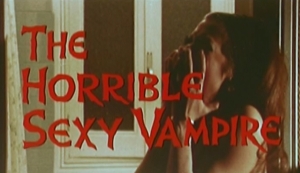
Movie Monday: Lessons on Writing from “The Horrible Sexy Vampire”

Horrible Sexy Vampire

The movie starts with an invisible murderer killing a man in the shower. Alright, not bad. Then what happens?

NOTHING. NOTHING HAPPENS. IT’S SO BORING.

Well then, what can we gain from watching The Horrible Sexy Vampire? It teaches a lot about how not to write dialogue—NEVER EVER write like this*. (Lines appearing one after the other are as spoken in conversation. I’ve tried to interpret the punctuation so you can “hear” it in all its glory.) Enjoy.

Unlikely characterization: “In my opinion, we cannot prove nor disprove the existence of vampires.” A pathologist, presumably a man of science, arguing with a logical police investigator.

Exhaustive exposition: I was going to transcribe the pathologist’s statement of how we “know” it’s a vampire going around murdering these people (including math equations!), but it’s just paragraph after paragraph of blather. The characters just stand there, static, while one talks at the other.

Awkward delays in plot: “That baron should be buried downstairs in the cellar, and so should his wife. We may be able to open their tombs.” “…What do you suppose they’ll hold, other than their crumbling bones?” “First we’ll have to find the door.” “Of course.”

“Explaining is stupid; why should I bother?” Yeah, I have nothing to say about that one.

“Written” language rather than realistic speech: “I dislike idle conjectures.”

Lack of editing-slash-logic: “…the last owner had no children.” “Are you referring to my mother?”

Characters don’t really talk to each other, they just talk: “Pardon my indiscretion, but what is it you do in London?” “Well, I’m not actually forced to do anything. I have a steady source of income and devote myself to my hobby of taxidermy. I should say I spend a huge amount of my time doing that.” “How interesting. You’re really most kind. Many thanks again.”

Throwaway dialogue: “What’s the time?” “It’s three past midnight go to bed.” “Tomorrow then bye.” (two barmaids)

Major lessons to take away: watch pacing and dialogue. Eliminate lengthy walking sequences where nothing happens. Make sure characters actually communicate instead of just blurting dialogue at each other. Also, edit for realism: I doubt a real cop would go on at length about intimate murder-case details to a perfect stranger (who, by the way, is also a suspect).

Runners-up for awfulness: One character literally rubs at his eyes in disbelief, on two separate occasions. Also, surprise vampire necrophilia.

Kudos, though, to the invisible vampire: a trait somewhat underused in vampire stories. That’s the only compliment I can give this one.

*This movie was originally in Spanish; but my argument stands. Someone still made these horrible dialogue choices when the screenplay was translated. And the plot speaks the universal language of suck.